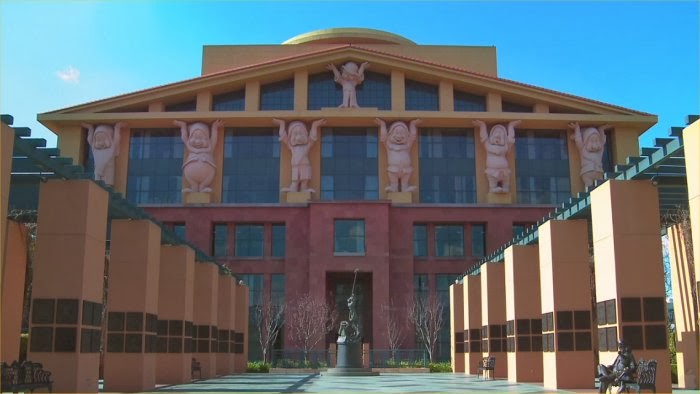
It seems to me whils not waiting in line at the supermarket that Disney and PXAR are like a see saw, when one is up, the other is down. This of course is not a hard and fast rule, and there are exceptions, for instance PIXAR released their first film in 1995, when Disney was coasting through the ninties, high on the Disney Renaissance, nonetheless the film was critically acclaimed. PIXAR animators recently spoke about the alleged rivalry between the two studios, passing it off as being healthy and necessary.
The ninties represented the height of disney animation, during the early ninties disney paid PIXAR, then a struggling graphics studio 10 million dollars to co-produce a piece of software with them that would allow them to paint the films using a computer, and bypass the ink and paint stage, when a deal could not subsequently be reached between the two companies, Disney gave PIXAR millions of dollars to produce their first animated feature film, it was called Toy Story. The relationship between PIXAR and Disney subsequently evolved with Disney buying the company in 2006 for 7.4 billion dollars, even more than they paid for LucasFilm. Disney's string of commercial and critical successes ended in 2000 with the release of Fantasia 2000 and Dinosaur, the first films in a long slump for the disney studios commercial and creative output, culminating with disney shutting down it's hand drawn animation department.
For contrast the 2000's represented the roaring twenties for PIXAR, producing a long string of critical and commercial successes. It did seem for a while like PIXAR was unstoppable, after film after film did well at the box office, and with the critics. WALL E, Ratatouille and UP were a string of particularly acclaimed film, coming one after the other. During this period Disney animation was in a slump, the company had failed to make the jump between hand drawn and computer animation, and their films were lacking in the visual and story departments, the box office returns weren't great either.Disney struggled to make the gap between the two mediums, and these films were always lacking visually, the studio underwent some reshuffling after the release of The Lion King, with Jeffrey Katzenberg relocating to Dreamworks for co-found Dreamworks Animation, thus the films that were released during the early 2000's were really the first to be developed after the departure of Katzenberg, a similar effect can be seen now with PIXAR, as the PIXAR films being released now are the first developed since the purchase of PIXAR by Disney, which perhaps explains their problems.
The period in which we are now living is known as the Disney Revival, a series of films higher in quality than those released in the early 2000's. In contrast, PIXAR is suffering what can only be described as a slump, since Cars 2 none of their films have reached the heights of PIXAR's golden age, this can be explained by some reshuffling having taken place since the companys acquisition by Disney.
What is interesting about the alleged rivalry is that each division tries to outdo the other on their own soil, and yet PIXAR rarely comes out on top, in 2007 Disney released Meet The Robinsons, about a boy inventor who travels forward in time, despite not being a huge critical or commercial success, the film is one of my favorites. The movie does tend to encroach on some PIXAR territory, but they do really well with it, and the film is a fun and touching father-son story, in addition to being a sci-fi movie and a buddy comedy. In 2012 PIXAR released Brave, an original fairy tale about a mother daughter relationship that goes awry. Despite not being a Cars 2 style faliure, the film just doesn't match up to Disney fairy tale adaptations like Beauty and the Beast, The Little Mermaid or Tangled, it pales in comparison, and although i have seen it one, i have absolutely no desire to watch it again, whereas i have seen tangled dozens of times, the PIXAR style of animation also doesn't translate well to fantasy stories, and the film doesn't have the painterly style of Tangled of the upcoming Frozen.
This is a tough post to write, as i truly do love PIXAR films, and i am hugely excited about their upcoming attractions, however the Disney Animation Studios is simply more versatile, and has a longer history, and they too have had their slumps, in fact from Sleeping Beauty to The Little Mermaid was one long slump. Overall these slumps are part of any studio, and this doesn't mean that PIXAR had 'had it' or that they're 'over', it simply means that their evolving into a full blown studio, and that this is a hugely exciting time to be a Disney animation fan, because when Disney nails it, they really nail it!
Thursday, 14 November 2013
Wednesday, 13 November 2013
Nobody Can Hear You Scream
Well i will start this review by saying that if you will need to go to the toilet, or want to make a cup of tea, then i suggest you do it now, we may be here for a while! GRAVITY is a 2013 science fiction film directed by mexican director Alfonso Cuaron. The film is set in outer space and follows Dr Ryan Stone, played by Sandra Bullock in real time as she completes a spacewalk and attempts to reach the international space station in order to return home. The film is notable for containing very few actors, and Bullock is joined by George Clooney who plays a seasoned astronaut attempting to break the record for the most hours spacewalked. These are the only two actors seen in the film, however we do hear a few actors voices, most notably that of Ed Harris, playing mission control in Houston, Texas. This is a funny tongue in cheek reference to Harris' role in Apollo 13, a fun reference for the cinemaphiles amongst us.
Gravity is a dramatization of the Kessler syndrome, in which the density of objects in orbit is enough that collisions could cause a series of chain reactions, each collision producing debris and thus increasing the likelihood of other collisions and making space exploration impossible. The film may be categorized as a thriller, being fairly dark in nature and the whole film being fairly high strung. Despite being a science fiction film, GRAVITY is much less allegorical than other Sci-Fi films, and is much less a tale of morals than say, 2001 or WALL-E. Instead GRAVITY is a psychological analysis, with the story being the example of a relentless murphys law and with Ryan Stone's solitude becoming a source of her strength, technology is also used as a metaphor in some cases with Stone finding the last bit of power on the spaceship, and the last bit of energy from within in order to survive.
GRAVITY is in 3D, and whereas most films use 3D to a financial end, GRAVITY takes 3D technology to new heights. GRAVITY is the third film that i have seen in 3D, and it is so far the only one that i felt would have been missing something without the added third dimension. The first film i saw was Toy Story 3, and whilst the 3D was perfectly acceptable, it was not a necessity, and the film was fine without it. The second film i saw was Iron Man 3, and whilst the 3D was tolerable, it was hardly necessary. GRAVITY would be a shame in 2D, as the 3D is used primarily to add dept, and the technology creates a point of reference which is useful, this is particularly important during the numerous scenes featuring space debris. In two dimensions there would normally be no real size difference between the debris and star, however in 3D the debris is in a different plane to the stars, and is thus easily discernible. The 3D allows us to experience the film, and to dodge pieces of solar panel with Ryan Stone, rather than just watching her dodge them!
George Clooney plays Lieutenant Matt Kowalski, the head of the mission, and a veteran astronaut. Kowalski as played by Clooney is charismatic, bright funny and caring, much like the man himself. Sandra Bullock plays Dr Ryan Stone, an engineer and rookie astronaut. Stone's character is headstrong, brave and focused, what is so amazing about this film is that despite the film not being very long and being told entirely in real time, we feel as if we know Bullocks character, and this is entirely thanks to her phenomenal skill as an actor, lets just give her the Oscar now shall we? GRAVITY also looks fantastic, and one might almost believe that this whole film was actually made in space, until logical reasoning tells us that this is impossible! The film is incredibly realistic and the visual effects are derived of necessity rather than animators attempting to prove their self worth.
Overall GRAVITY is a film that transcends genre, only enhanced by 3D GRAVITY is a film which encourages the audience to experience it, to live it rather than to simply watch it, and which is not simply a trip to the cinema, but a trip to outer space, these stars will shine for light years to come. Rating: A+
Matt Kowalski:
Houston, I have a bad feeling about this mission.
Monday, 11 November 2013
Waking Sleeping Beauty
Last night i had a bit of a surprise, i had always been fascinated by disney animation, and growing up during the disney renaissance, and living now through the disney revival, i was intrigued by Waking Sleeping Beauty, a documentary detailing the rebuilding of the animation department during the late 80's and early 90's. The film is produced by the Walt Disney Company itself, and yet provides an honest and unbiased insight into the period between the production of The Black Cauldron and The Lion King.
The film is notable for the fact that it uses no new filmed interviews, instead it uses new audio recordings and archive footage, most of it filmed guerrilla style without permission by employees of the animation department, as well as vintage recorded interviews and clips from various disney movies of the era. The film starts by detailing the state of the animation department at the height of its success, just before the release of the lion king, when the money was pouring in and animation had become a powerhouse again, the movie then details the era from 1984 up to this point, showing the rebuilding of the animation department.
The film, despite being released by Walt Disney Pictures, offers an unbiased and honest account of this period, the film openly depicts the infighting and tension of this period. The company was being restructured and Michael Eisner was brought in as chairman, and he brought in Jeffrey Katzenberg, his colleague from Dreamworks. He quickly ruffled feathers by personally editing The Black Cauldron, to make it more child friendly, and insisting that he wanted to win the 'Bank of America Award'. The artists were terrified they were going to be layed off, they were finally unceremoniously evicted from the inking and painting building on the disney lot, and forced to move into a delapidated warehouse in glendale, a big shock for the department who developped Cinderella and Peter Pan. From the ashes the animation department rose into flame and produced some of the best animated films of all time.
Overall i found the film to be surprisingly honest, the film despite being produced by the Walt Disney Company, doesn't sugar coat any of the events portrayed, and is honest about the sleepless nights, the long hours, the carpal tunnel and the overworking, and is refreshingly honest about the difficulties of working for the Walt Disney Company, including dealing with difficult bosses, including Roy E Disney, Walt's nephew.
Waking Sleeping Beauty is a surprisingly watchable film, and doesn't sink to the salacious depths of other Michael Moore style documentaries, and manages to be surprisingly balanced, not having a singular narrative voice, but many, the film, if one has to see a point of view, is essentially from the point of view of the artists, and tends to empathize with them rather than the management or the marketing department, interesting considering that disney is a mega-corporation known for marketing themselves as being like a family. Waking Sleeping Beauty is a surprisingly fascinating look into one of the most tumultuous and groundbreaking decades in the history of animation. Rating: A-
Sunday, 10 November 2013
American Horror Story
American Horror Story is an anthology series created by Ryan Murphy, creator of Glee and Nip/Tuck. The series premiered in 2011 on the FX network, a premium cable network. The series is an anthology series, it retains the same cast, but features a different storyline, characters and setting.
The first season was retrospectively called Murder House. The series features a husband and wife who relocate to Los Angeles from Boston after he has an affair, with their daughter, things take a turn for the worst when it turns out their house is haunted with the ghosts of the hundreds who died there.
The second season is titled Asylum, and takes place in a spooky and atmospheric mental asylum run by nuns in 1964 in Massachusetts. The series features much of the same cast as the first, with some additions. The series features Jessica Lange in a pore prominent role than in series 1, as the sadistic and cruel Sister Jude, who runs the asylum.
Finally season 3 is titles Coven, and takes place around a school for witches in Louisianna, run by Cordelia Foxx, played by Sarah Paulson. The series is notable for the return of Tassa Farmigia and the introduction of Emma Roberts, both as witches.
The series is an anthology series, and this solves various problems. The first problem it solves is boredom, many tv series have been cancelled after a certain number of seasons, due to fans becoming bored of the characters, the plot arcs or becoming turned off due to the addition of certain characters. The
advantage of the anthology series is that it never becomes old, because it is like having a new series every year, but built on the back of the same brand, leaving room for artistic vision, without artists having to get their ideas continually validated by network chiefs.
The other problem that this gets around is attracting new viewers, many potential new viewers get put off by having to sift through multiple seasons of a show simply to understand what the hell is going on, American Horror Story does not have this issue, as every season is different, so viewers can watch the seasons in any order, or simply watch only one of the seasons.
AHS is also a lot of fun, the series is gory, scary and sexy. It features blood, sex and thrills, and is unafraid to be overtly provocative. The series manages to be an intelligent example of the horror genre, rather than simply an excuse for the writers to see their fantasies played out on screen. It is almost a shame that such a cinematographically rich series, has to be resigned to the small screen.
Monday, 4 November 2013
Carrie Bradshaw VS Bridget Jones
Well, i am a huge fan of Sex and the City and of Bridget Jones Diary, they are both cinematic icons and i was inclined to compare the two. No real logic, just a whim!
Both films represent something of a stereotype on either side of the pond. Both are characters talking frankly and honestly about being single and dating in your thirties, funnily enough although these characters represent the same social group in society, the characters themselves couldn't be more different. Bridget Jones is a woman who is socially awkward, slightly chubby, frumpily dressed and with an overbearing, mortifying mother. Carrie Bradshaw is naturally stylish and always impeccably dressed, skinny and affluent. Interestingly enough they both work in publishing, Carrie writing a column for The New York Star, and Bridget for a publishing house.
Both detail their lives through written media, Carrie writes a column every week, detailing her and her girlfriends sex life, and Bridget through writing her diary. Both were also avid smokers, and Bridget started every entry with the number of cigarettes smoked. What is interesting about these characters is how they both represent an ideal. The british ideal is seen as someone tangible, someone real, whearas the american version is a complete fantasy. Don't let it seem like i am disrespecting SATC, i absolutely adore this show, (in fact i'm watching it right now) it's just that it represents a complete fantasy, people don't really dress like this or talk like this, people don't go out for cosmopolitans every night and they don't own huge manhattan appartments with even bigger manhattan closets. Bridget Jones is the complete antithesis of this ideal, Bridget is a character who despite being socially awkward and relatively unattractive, manages to be witty and clever, whilst perhaps not having some of the panache of her american counterparts.
Saturday, 2 November 2013
La Vie D'Adèle
Blue is the warmest color is a 2013 french
film directed by Abdellatif Kechiche and starring Adèle Exarchopoulos and Léa
Seydoux. The film is adapted from the French graphic novel Blue Angel. The film
first premiered at the 2013 Cannes Film Festival, and many festival goers were
shocked by the lengthy and graphic sex scenes, nonetheless the film went on to
win the Palme D’or, and not only was its director awarded, but also its main
actresses. The lead actresses are only the second and third women to win the
award.
Adele plays Adèle, a 15 year old student
living in a suburb of Lille with her parents, and studying for her Bac, she meets
a male student with whom she has a casual fling, but feels nothing, and despite
having passionate sex with him, she finds herself sobbing unconsolabley
afterwards. Another female student makes advances on her, advances that Adèle
returns, and Adèle, thinking them to be in a relationship, pursues the fellow
student, the student tells her that she is not lesbian and doesn’t want a
relationship with her. Finally, Adèle meets Emma, an art student with blue
hair, studying at the Beaux-Arts. Adèle launches into a hedonistic, passionate
relationship with Emma, much to the dismay of her schoolfriends, the only
friend who doesn’t treat her with judgement is Valentin, another gay student.
Their relationship continues, and they each decide to introduce the other to their
parents, Emma’s parents are open, understanding of their relationship and
approving, they also see the need for people to follow their dreams. Adèle’s
parents on the other hand do not see the true nature of their relationship and
ask pointed questions about Emmas boyfriend and feel that it is important to
have a career which makes money. Despite their differences in background and
age, Adèle and Emma continue their relationship.
A few years later Adèle is working as a
primary school assistant, and is still in a relationship with Emma, now an up
and coming artist. Adèle enjoys her work as an assistant and hopes to become a
teacher, Emma is now moving with a different crowd, and has a new group of
cool, arty friends. Adèle and Emma now has sex far less frequently, and Adèle,
feeling left out, starts a tryst with a fellow male assistant. When Emma finds
out, she is livid, and throws Adèle out of her home, Adèle is distraught, and
as the months stretch on, reconciliation seems impossible.
The films lead actresses are superb, and
Cannes was perfectly justified in awarding the palme d’or to the actresses as
well. Adèle Exarchopoulos plays a young woman who is fragile, complicated and
naive, and who falls head over heels in love. Her actions though not always right
are justified by the audience, because we feel just as head over heels in love
with our heroine does as Emma does. Adèle’s performance is powerful and raw, and
almost impossibly real, sont, tears and all Adèle is as real a figure as ever
was shown in a motion picture. Léa Seydoux plays Emma, a confident and creative
young woman. Seydoux’s character, despite not having quite the emotional range
of Adèle, is also very real. Her character is also less conflicted, and perhaps
Léa Seydoux ability as an actor is less evident from this picture, but her
portrayal of a beautiful and intoxicating young woman is powerful none the
less.
Blue is the Warmest Color is a very long
film, at just under three hours long, a film with so little story may seem like
drag, but it is not. Previously this length of film was limited to action films
and epics, Blue is the Warmest Color is a film which not only has a relatively
small cast, but also a rather small plot, the film is far from boring, and much
of the screen length is due to the use of numerous long takes, and the fact
that the film is told in two parts. As I stated Blue is a film which uses
numerous long scenes, in some ways the film is like a play, and most of the
scenes are simple two person dialogues about love, life and innocence. Blue is
the Warmest Color is a film which doesn’t need action scenes or violence to be
enthralling, and which manages to rely solely on dialogue, and the emotional
journey upon which the film takes the audience, and the realization of this emotion
fully justifies the films length.
Director Abdellatif Kechiche manages to
successfully champion the extreme close-up. For those of us who abhorred Les
Misérables for its misuse and overuse of the close up, Blue is the Warmest
color gets it right. The close ups are used here to show us the pure emotion of
the story, and to showcase the viewpoints of the characters. He also manages to
successfully use the handheld camera, a technique that has become popular in
recent years, used mostly in order to make films appear ‘artistic’. Often this
only has the effect of making the film seem pretentious and the effect is
irritating if misused (see The Place Beyond the Pines). Handheld camera work is
most effective if it is used out of necessity and not for artistic measure. Seeing
as much of Blue is the Warmest Color was filmed on location in Lille, and many
of the sets that were used were rather small, the use of handheld filming
probably derives from necessity, and not from any desire to create anything
resembling art.
The color blue also features heavily
throughout the film, as may be expected. At the start of the film, and
throughout the first chapter, Emmas hair is blue. Adèle’s bedroom is also blue,
and many of the films pivotal scenes take place there. In the second chapter of
the film, Emmas hair is blonde, however the color still features heavily, in
the café where Emma and Adèle meet, Emma is seated in front of a blue wall,
which frames her with a blue halo, and in the final scene, Adèle wears a blue
dress, and a bystander notices that blue is a color which suits her well,
perhaps a reference to the fact that despite them no longer being together,
Emma and Adèle will always be soulmates.
I could not write a review of this film
without referring to its numerous sex scenes. Many audience members at Cannes
were shocked by these scenes which are long, unedited and graphic. The scenes
are so realistic and so explicit that members of the cast were forced to
explain that the scenes were in fact stimulated. The film contains numerous sex
scenes and they are frank, graphic and overt. What I love about these scenes is
that they are unabashed and sexual, and nothing is implied à la Brokeback
Mountain. The first scene is between Adèle and a boy she is seeing, the scene
is notable for the fact that it contains the first glimpse of erect penis that
I personally have ever seen in a mainstream film. All of the subsequent scenes
take place between Emma and Adèle, and feature exclusively in the first
chapter. The scenes, while perhaps shocking, serve to show us the passionate
nature of the relationship, and the absence of these scenes in the second
chapter show us how their relationship has become less passionate, and how
Adèle feels left out.
Overall, Blue is the Warmest Color is a
fantastic film, it is passionate, dark and poetic. The film is a fascinating
insight into the relationship between two people and manages to successfully
translate the powerful emotion that comes with heartache to screen without
becoming soppy or melodramatic. The film contains powerful performances from
its leads and frank, graphic sex scenes that are honest and realistic. Blue is
the Warmest Color is a film which is as real as any film can be. Rating: A+
Friday, 25 October 2013
Ja'mie: Private School Girl
the 23rd of October marked the premiere of Ja'mie: Private school girl. This Australian series is created by Chris Lilley, creator of Summer Heights High, Big Bite and Angry Boys. The series brings back Ja'mie king, star of Summer Heights High and We Can Be Heros. The series is filmed in the familiar mockumentary style that has been used for all of Lilley's projects to date. The film features some of the cast previously used in SHH and We Can Be Heroes, such as Hilford Girls Grammar Headmistress.
The series stars 17 year old Ja'mie King, who is revealed to previously have been called Jamie, but who added the apostrophe in year eight, after leaving Summer Heights High and going back to Hilford Girls Grammar. The series details her last year at school; 'and the events that changed her life forever!' The series is a direct continuation of the character, and people who were mentioned in other series are also mentioned, such as Ja'mie's former best friend Brianna.
I really liked the premiere of this series, Lilley doesn't rest on his laurels, and despite already having created a well rounded character, Lilley adds characterizations previously unseen, such as the word 'Quiche' (meaning more that hot, like really really hot) a box gap (the gap batween your thight, because no one want's their thighs to be rubbing together) and vag-aterians (lesbians). This shows how Lilley doesn't simply want to show us more of this character, but also to add to this character, and to update it.

I really really like the series, Lilley doesn't hold back in giving us bitchiness and meanness, Ja'mie is shown as being vacuous, shallow, cruel, and supremely entertaining, what can i say, i laughed a lot! Rating: A
My Names Ja'mie, and I'm a private school girl
Wednesday, 23 October 2013
I Love You Mommie Dearest
Mommie Dearest is a 1981biopic, detailing the later years of famed screen siren Joan Crawford, and her troubled relationship with her adopted daughter, actress Christina Crawford. The film is an adaptation of Christina Crawfords memoir of the same name. The film stars Faye Dunaway as Crawford, in a truly chameleonic performance. The film received mixed reviews upon release and won the razzie award for worst picture, the film has since however gone one to become a cult classic.
The film, much like the novel, uses a cinematic form of first person narrative. The novel is a memoir, and is thus neither a factual account nor an unbiased documentary, the film is instead a work of fiction which is based upon one persons account of events, which do not claim to be unbiased or balanced. The problem with this is that it makes the film seem over the top and a little camp, whereas in the novel, the scene of Joan attacking her daughter for using a wire hanger and morphing into a complete monster may work in a novel using first person narrative. In film, despite many attempts to subvert this, narrative is nearly always third person, as most of the time we are watching the film as an outsider, and thus the gloriously over the top performance by Faye Dunaway whilst perhaps being appropriate to the character described in the novel, needed to be toned down for the film.
The film describes the period from Crawford's adoption of Christina, until Crawford's death. The film shows Crawford to be a rigorous and almost pathologically disciplined person, she rises at dawn to perform a precise beauty regimen, has a crippling exercise regime and peruses scripts with a highlighter, the character's career is shown to be steadily on the decline, and her companion notes that she is getting older. Her films are grossing less and less money and she is becoming known as box office poison, she is released from her contract at metro, a grievance which she unabashedly takes out on her children, who are now about ten. She then attempts to make a comeback, campaigning and auditioning for the part of Mildred Pearce, the role that would eventually win her an Oscar.
The latter part of the film details her declining relationship with her daughter, now a young woman, and aspiring actress, and her declining health, this part of the film is considerably less camp than the first part, and despite being perhaps less salacious, it is considerably more interesting, as it is an intense study of the terse relationship between mother and daughter, and offers much more in the way of real information than the shrill first half of the film.
Faye Dunaway is fantastic as Joan Crawford, it is never easy to impersonate another, particularly someone as iconic and beloved as Joan Crawford, what is impressive is not only her metamorphosis into Crawford, but the way she manages to present a rounded view of a truly horrific woman. Despite Crawford being unabashedly the villain in this film, Dunaway plays her in such a way that we understand her as a person, and she does not become two-dimensional.
As i mentioned before, this film is incredibly camp, Dunaways performance is, at times gloriously over the top and sometimes plain daft, she has emotional depth and manages to steal every scene in which she sets foot. The film also suffers from pacing issues, and various moments in the film (mostly when Dunaway is offscreen) can seem a little dull, the film also feels the need at times to resort to bitchy salaciousness, which does often feel unnecessary, and cheapens the whole film.
Overall Mommie Dearest is a perfectly enjoyable, and rether watchable film, featuring a strong lead performance from Dunaway as Crawford. Despite the film not providing any real insight into the private life of such a regimented woman, it is an entertaining watch none the less. Rating: B
Joan Crawford:
No wire hangers, EVER!
Saturday, 19 October 2013
Five Favorite Disney Films
It should come as no surprise to anyone who reads my blog on a regular basis that i am a huge disney fan, in fact this is the third post in a row on disney, i really should find another subject or i may have to rename this blog, however i finished an exam today, and decided to relax by watching one of my favorite disney films 'One Hundred and One Dalmatians'. Disney has the longest history and the largest back catalogue of animated films, and produced the first ever full length animated feature, Snow White and the Seven Dwarves. Disney successfully parlayed into making computer animated movies, and acquired PIXAR in 2007, securing their role as the top animation studio. I decided to compile a list of my favorite Disney films, a list i compiled in my head last night, as i was unable to sleep! So in no particular order, here goes!
1. Tangled: This might seem like an odd choice, but this film really is fantastic, catchy songs, and modern animation make this film a contemporary classic. The film is somewhat of a game changer for disney, and was the first non PIXAR computer animated film to show real beauty, the film manages to successfully blend computer animation with traditional animation to create something truly beautiful, and bears no resemblance to generic Dreamworks computer animated films. A modern reworking of a classic fairytale makes for fabulous viewing, and a modern classic.
2. Meet the Robinsons: Again, might seem like an odd choice, this computer animated film was the first computer animated film released by disney that really made the studio a true competitor for PIXAR. The film has a fun engaging script, an interesting and intelligent plot involving time travel, that could rival Doctor Who, and features some beautiful animation. The film is different from most disney features, in that it appeals more to boys than girls and is not a musical, it also takes place in no particular time frame, and the time travel element means that it could take place in any era, this is a fun animated feature, where actions have direct consequences and the future may not be as rosy as we would like to believe, and which manages to successfully bring disney animated features into the modern era.
3. One Hundred and One Dalmatians: I have often talked about my love for this film, and have seen it a great number of times, the first film to use the xerox process and the start of the modern era. The first film not to be inked by hand, the xerox process gave the film a modern, cartoon look. The backgrounds were painted by hand and then had ink cells put over the top, giving the backgrounds a modern art look, given that the outlines don't quite match up with the watercolors. This is also one of the few films in which the backgrounds are drawn in the same style as the characters, giving the film true coherence, the iconic voice of Rod Taylor as Pongo make this film an entertaining and artistic film.
2. Fantasia 200: The first animated film to be screened in IMAX, this followup to Walt Disney's 1940's anthology has more coherence than the original, and is a half step between hand drawn animation and computer animation, parlaying disney into the new millennium. Well known and iconic recordings make this more entertaining and beautiful than the original, the highlight is the outstanding Rhapsody In Blue, a daringly different piece of animation with real style depicting a construction worker in 1920's Manhattan, and The Carnival of the Animals, a funny piece about a flock of flamingos, and a yo-yo.
1. The Lion King: I know i said that this list was 'in no particular order' but i lied, The Lion King takes the bait as the best animated feature of all time. Fantastic music by Sir Elton John and Tim Rice, and beautiful vistas make this a fun ride. A daringly original story and iconic voice actors help make this film a fantastically fun ride. I guess it also helps that it was released a year after i was born, and thus summons up feelings of nostalgia from anyone who grew up during the ninties.
Any comments? Which Disney films are your favorites?
Monday, 14 October 2013
Computer generated VS Hand Drawn
In april 2013, Disney gutted their entire hand-drawn animation staff, firing all of their animators. All of Disney's upcoming announced films are computer animated, and many films previously announced as being traditionally animated were subsequently re-announced as being computer animated. The last traditionally animated films to be released by Disney were 2009's The Princess and the Frog and 2011's Winnie the Pooh.
Disneys upcoming musical film 'Frozen', a loose adaptation of Hans Christian Anderson's The Snow Queen, was previously announced as a traditionally animated film, before being retooled to use the same technique and visual style as 2010's Tangled. An upcoming film detailing the story of the Easter Island Idols was originally believed to be traditionally animated, however was subsequently announced as a computer animated film. All is not lost however, short films are still being traditionally animated, Frozen is being preceded by a Mickey Mouse short, which is being traditionally animated, and which is being projected in 3D. At the most recent Academy Awards, the award for best animated feature, went to Paperman, this black and white Disney short managed to blend 3D computer animation and 2D traditional animation effectively, creating something modern and timeless.
Will computer animation ever be as good as traditional animation? I think yes, i feel that in the past, computer animation was clunky and unrefined, and attempted to translate live action films directly to animation, and these films often failed to bridge the uncanny valley and ended up looking ugly and hyper-real. This changed with Tangled however, Tangled combined methods of computer animation with traditional animation, using non-photorealistic animation, and creating vistas akin to pre-raphelite paintings. This represented a huge turning point for computer animated films, with computer animation finally being as textured, layered and beautiful as some traditional animation.
Don't get me wrong, traditional animation is wonderful, however the bean counters at Disney aren't happy, Winnie the Pooh barely made back it's meager 30 million budget, and The Princess and the Frog's 300 million gross pales in comparison to the 550 million made by Tangled. 3D has only been used with hand drawn animation experimentally, and only the 3D re-release of The Lion King made any real money for Disney, with disney subsequently cancelling re-releases of Aladdin and Tarzan.
Overall i think we will see a return to hand-drawn animation, but only when animators have figured out how to use it successfully in conjunction with 3D. Both techniques can be beautiful when used correctly, and Tangled ushered in a new era of computer animation. Until the return of traditional animation on our screens, we will have to console ourselves by just watching Sleeping Beauty over and over again!
![]() |
| Fron Disney's Tangled |
![]() |
| Concept art for Tangled's Rapunzel |
Will computer animation ever be as good as traditional animation? I think yes, i feel that in the past, computer animation was clunky and unrefined, and attempted to translate live action films directly to animation, and these films often failed to bridge the uncanny valley and ended up looking ugly and hyper-real. This changed with Tangled however, Tangled combined methods of computer animation with traditional animation, using non-photorealistic animation, and creating vistas akin to pre-raphelite paintings. This represented a huge turning point for computer animated films, with computer animation finally being as textured, layered and beautiful as some traditional animation.
Don't get me wrong, traditional animation is wonderful, however the bean counters at Disney aren't happy, Winnie the Pooh barely made back it's meager 30 million budget, and The Princess and the Frog's 300 million gross pales in comparison to the 550 million made by Tangled. 3D has only been used with hand drawn animation experimentally, and only the 3D re-release of The Lion King made any real money for Disney, with disney subsequently cancelling re-releases of Aladdin and Tarzan.
![]() |
| Still from Dinsey's Paperman |
Sunday, 13 October 2013
Notre Dame de Paris
The Hunchback of Notre Dame is a film released by Walt Disney Pictures during the disney renaissance. The film is loosely adapted from Victor Hugo's acclaimed 1831 novel. The film focuses of the bellringer of Notre Dame cathedral on the Ile De la Cité, and his relationship with Judge Claude Frollo, a man who he refers to as 'Master', who rescued him when he was a baby, and who teaches him that the world is a cruel place. The film tones down the characters religious undertones, in the book he is an archdeacon, whereas in the film he is a Judge, with clear religious affiliations. The film is darker in tone than most disney films, and liberally uses gothic and religious undertones.
The film is stunning, and uses computer animation to create fantastic animated backgrounds, traditionally on hand drawn animated film the backing plates are hand painted and never move, on Hunchback, the backings are computer animated, and thus the film turns into a beautiful living painting. The backing plates still look hand painted, but they move, and the bells actually swing, a rarity in hand-drawn animated films. The look of the film is also much darker than other traditional disney films, ironically with light being used to great effect. This is one of the first times that actual rays of light were used on animated films, an, with Quasimodo showing Esmeralda the sunset over the city of Paris, and Notre Dame Cathedral peeking through the clouds and being lit by the morning sun, Notre Dame cathedral is also show looming ominously over the city of Paris, with the people and the houses being miniscule in comparison.
The film is highly critical of organized religion, whilst also being a commentary on faith and belief. The films villain, Judge Frollo has clear religious affiliation, with hig wearing a high collared shirt, much like a priest, and black robes like a Franciscan monk. Frollo believes that it is his job to purge the world of sinners, and all those he considers unworthy and evil. He believes that his work is all supported by gods will, and thus that he is fundamentally right. His views are often those supported by fundamentalist christian groups, as he is racist, bigoted and arrogant, and believes that he is above all laws, even gods law, as he frequently breaks the 10 commandments. The character acts as a symbol of religious hypocrisy, preaching about good and lust, yet having deeply lustful feelings towards Esmeralda, asking her to 'choose him or the fire', architecturally the cathedral looms ominously over the city, dwarfing all and sending a message about the oppressiveness of organized religion.
Another message of the film is that of acceptance and equality, the film teaches us to accept people who may be different to them, Frollo wishes to eradicate paris of gypsies, feeling them to be evil and impure. This situation mirrors what is happening in western europe at the moment, as local governments attempt to eradicate gypsies presence, trying to flush them out by depriving them of water, sanitation and electricity, and making them feel like vermin. The film eventually teaches tolerance, and justice, and although Frollo is a judge, he preached his own, narrow form of justice, and had no respect for true equality.
The film also teaches the message that people are inherently good. Frollo tells Quasimodo that the world is a cruel dark place, and that he must stay inside the cathedral for his own protection. Quasimodo eventually learns that the world is a place that is inherently good, and that people are generally good, this is illustrated when a young girl hugs his, in spite of his hideous appearance. Esmeralda treats Quasimodo without judgement of pity, despite how he looks, and he in return provides her with protection.
The film can also be seen as a commentary on faith, as opposed to religion. Characters who are encouraged to believe in damnation and hell, find god through beauty. The beauty of the sunset above the streets of Paris and the beauty, inside and out, of the character of Esmeralda. The film is a critique of the way religion divides people, and how it encourages people to fear damnation, Frollo tells Esmeralda that he will smite her into the fires of hell, right as he falls off the parapet into the molten lava below. It also states that what you see isn't what you get, and the audience is encouraged to divine 'who is the monster and who is the man'.
Overall 'The Hunchback of Notre Dame' is a fantastically rich and complex tale which does justice to Hugo's original tale, whilst altering it to make it appropriate for a younger, modern audience, and while diluting some of the more overtly provocative themes. The music is also fantastic, and a chorus is heavily featured in this film, inkeeping with the films religious undertones. The Hunchback of Notre Dame is a forgotten classic, which has been unfairly overshadowed by other films of the Disney Renaissance. I guess it helps that the film agrees with my personal political beliefs. Rating: A-
Frollo:
The time has come, Gypsy. You stand upon the brink of the abyss. Yet
even now it is not too late. I can save you from the flames of this
world, and the next. Choose me, or the fire.
Wednesday, 9 October 2013
An English Rose
Diana is a 2013 english language film detailing the final years of The Princess Of Wales' life, focusing mainly on her relationship with heart surgeon Hasnat Khan. The film stars Naomi Watts as Lady Di, and begins with her split from Charles, The Prince of Wales. The film focuses exclusively on Diana, and the royal family is never featured, save for a single shot of the princes, though they are discussed extensively.
The film does have a rather melodramatic tone, which led many reviewers to write the film of as being histrionic melodrama, however given that the film is unabashedly from Diana's point of view, and that we do tend to dramatize events in our life, seeing the film entirely through her eyes, allows some dramatization of events, we believe entirely in her actions, and her actions require no justification. Part of what makes this film so successful is that whilst watching the movie, we never doubt our heroine's actions, and the film never attempts to justify them, it is only upon reflection that we realize how painfully flawed she is.
Naomi Watts is fantastic in the title role, and really is a doppleganger for Lady Di herself, Watts has to carry the entire bulk of the film, and is literally in every scene, she has to be respectful of the beloved princess, whilst also presenting her as a real person. What angered the british public about this film is that it shows the Princess' flaws, which some found tacky, what makes this film a success is conversely that it refuses to place it's lead on a pedestal, and that instead of giving us a cardboard-cutout for a heroine, we are given a real human being. This film does have a lot of flaws, but Watts isn't one of them.
The film doesn't have quite enough storyline for it's two hour running time, the film really could be a half hour shorter. After a while the film does start to feel a little episodic, and Diana and Khan break up so many times that the film does start to feel a little been there, done that. The film does however do a great job of showing the person behind the legend.
Overall Diana, despite not being perfect, is simply not the turkey that many wrote it off as, Watts gives a fantastic and complex performance of a complicated and troubled princess. The film gives us an interesting insight into the life of a woman everyone thought they knew, and who was loved intensely by the British public. The film is an emotional roller-coaster, yet is sometimes painfully flawed, much like the princess herself. Rating: B
Subscribe to:
Posts (Atom)