Showing posts with label Classic. Show all posts

Thursday, 12 June 2014

Adapting Wonderland

I will start today's post, like so many, with a story, the other night i decided to watch Tim Burton's 2010 adaptation of Alice In Wonderland, a happy accident lead to me actually watching the Walt Disney 1951 animated classic. I had seen the animated film before, but not for some years, and in re-watching the movie, i discovered it to be an interesting an beautiful picture if not a particularly watchable one, i watched the Tim Burton version the following day, and found it to be again a beautiful picture but nonetheless a flawed one.
Disney adapted Alice in Wonderland first in 1923 as a 21 year old student, however the film, which was part live action was never released to the public, and after the success of Snow White in 1938 he decided to make the film, Disney made several attempts to streamline the story and convert Carroll's nonsense literature into something less episodic and more suitable for film, however with limited success, as the movie still feels highly disjointed. Tim Burton's Alice is far more successful, however i use the word more with caution, as the story still has problems, despite being far more effectively streamlined, the story still lacks an emotional connection, and we never really get to know Alice Kingsley as a person, despite her being given a slightly more fleshed out back story than in the original film. The plot of the film is more successful, Burton creates a trajectory and a story arc for Alice that is lacking in the original version, unfortunately the plot, although successful uses a plot device about a character embracing their destiny which at this point is incredibly overused.
Visually both films are stunning, the 1951 film was designed mainly by Mary Blair, who would subsequently become renowned for her work on the theme park ride Its A Small World, the film is a visually delightful psychedelic adventure, no doubt slightly LSD inspired, however the imagery in this version remains reasonably light, the 2010 adaptation is another story. Tim Burton's film, is, to put is simply, a Tim Burton film. The film is visually quite dark, and the world of wonderland was created entirely on a green screen. This was not entirely de rigeur at the time like it is now, and Alice In Wonderland was really only the second film after Sky Captain to use this technique.
Extensive green-screen usage is seen to be incredibly easy, but it is actually incredibly difficult and can be jarring if not used properly, Oz the Great And Powerful used a similar effect for the Brick Road sequences, and with no reference point between the actors and their environments, and no interaction, everything looks out of perspective, and the actors look oddly small, this effect is absent from Alice, and this is partly due to Burton successfully blending the actors with their environments, some characters are entirely CGI, some are a blend of CGI and live action, some are live action that has been modified using CG, such as the Red Queen's head and Tweedledee and Tweedledum. The film is a seamless blend, and although being visually spectacular, the effect was never jarring.
Both films were hugely influential, the 1951 film which rode on the wave of fairy tale adaptations started by Snow White, and it later convinced Disney to search for the rights to other literary works such as Peter Pan, Winnie the Pooh and Mary Poppins. The 2010 film was responsible for the recent wave of fairy tale live action adaptations which include the recently released Malecifent and Oz, The Great and Powerful. The film was also responsible for studios taking fairy tale heroines and making them warriors in armour with a sword, a trend which is rarely well achieved. However both of these films remain visually delighting adventures.

Monday, 4 November 2013

Carrie Bradshaw VS Bridget Jones

Well, i am a huge fan of Sex and the City and of Bridget Jones Diary, they are both cinematic icons and i was inclined to compare the two. No real logic, just a whim!
Both films represent something of a stereotype on either side of the pond. Both are characters talking frankly and honestly about being single and dating in your thirties, funnily enough although these characters represent the same social group in society, the characters themselves couldn't be more different. Bridget Jones is a woman who is socially awkward, slightly chubby, frumpily dressed and with an overbearing, mortifying mother. Carrie Bradshaw is naturally stylish and always impeccably dressed, skinny and affluent. Interestingly enough they both work in publishing, Carrie writing a column for The New York Star, and Bridget for a publishing house.
Both detail their lives through written media, Carrie writes a column every week, detailing her and her girlfriends sex life, and Bridget through writing her diary. Both were also avid smokers, and Bridget started every entry with the number of cigarettes smoked. What is interesting about these characters is how they both represent an ideal. The british ideal is seen as someone tangible, someone real, whearas the american version is a complete fantasy. Don't let it seem like i am disrespecting SATC, i absolutely adore this show, (in fact i'm watching it right now) it's just that it represents a complete fantasy, people don't really dress like this or talk like this, people don't go out for cosmopolitans every night and they don't own huge manhattan appartments with even bigger manhattan closets. Bridget Jones is the complete antithesis of this ideal, Bridget is a character who despite being socially awkward and relatively unattractive, manages to be witty and clever, whilst perhaps not having some of the panache of her american counterparts.

Wednesday, 23 October 2013

I Love You Mommie Dearest

Mommie Dearest is a 1981biopic, detailing the later years of famed screen siren Joan Crawford, and her troubled relationship with her adopted daughter, actress Christina Crawford. The film is an adaptation of Christina Crawfords memoir of the same name. The film stars Faye Dunaway as Crawford, in a truly chameleonic performance. The film received mixed reviews upon release and won the razzie award for worst picture, the film has since however gone one to become a cult classic.
The film, much like the novel, uses a cinematic form of first person narrative. The novel is a memoir, and is thus neither a factual account nor an unbiased documentary, the film is instead a work of fiction which is based upon one persons account of events, which do not claim to be unbiased or balanced. The problem with this is that it makes the film seem over the top and a little camp, whereas in the novel, the scene of Joan attacking her daughter for using a wire hanger and morphing into a complete monster may work in a novel using first person narrative. In film, despite many attempts to subvert this, narrative is nearly always third person, as most of the time we are watching the film as an outsider, and thus the gloriously over the top performance by Faye Dunaway whilst perhaps being appropriate to the character described in the novel, needed to be toned down for the film.
The film describes the period from Crawford's adoption of Christina, until Crawford's death. The film shows Crawford to be a rigorous and almost pathologically disciplined person, she rises at dawn to perform a precise beauty regimen, has a crippling exercise regime and peruses scripts with a highlighter, the character's career is shown to be steadily on the decline, and her companion notes that she is getting older. Her films are grossing less and less money and she is becoming known as box office poison, she is released from her contract at metro, a grievance which she unabashedly takes out on her children, who are now about ten. She then attempts to make a comeback, campaigning and auditioning for the part of Mildred Pearce, the role that would eventually win her an Oscar.
The latter part of the film details her declining relationship with her daughter, now a young woman, and aspiring actress, and her declining health, this part of the film is considerably less camp than the first part, and despite being perhaps less salacious, it is considerably more interesting, as it is an intense study of the terse relationship between mother and daughter, and offers much more in the way of real information than the shrill first half of the film.
Faye Dunaway is fantastic as Joan Crawford, it is never easy to impersonate another, particularly someone as iconic and beloved as Joan Crawford, what is impressive is not only her metamorphosis into Crawford, but the way she manages to present a rounded view of a truly horrific woman. Despite Crawford being unabashedly the villain in this film, Dunaway plays her in such a way that we understand her as a person, and she does not become two-dimensional.
As i mentioned before, this film is incredibly camp, Dunaways performance is, at times gloriously over the top and sometimes plain daft, she has emotional depth and manages to steal every scene in which she sets foot. The film also suffers from pacing issues, and various moments in the film (mostly when Dunaway is offscreen) can seem a little dull, the film also feels the need at times to resort to bitchy salaciousness, which does often feel unnecessary, and cheapens the whole film.
Overall Mommie Dearest is a perfectly enjoyable, and rether watchable film, featuring a strong lead performance from Dunaway as Crawford. Despite the film not providing any real insight into the private life of such a regimented woman, it is an entertaining watch none the less. Rating: B

Joan Crawford: No wire hangers, EVER!

Sunday, 13 October 2013

Notre Dame de Paris

The Hunchback of Notre Dame is a film released by Walt Disney Pictures during the disney renaissance. The film is loosely adapted from Victor Hugo's acclaimed 1831 novel. The film focuses of the bellringer of Notre Dame cathedral on the Ile De la Cité, and his relationship with Judge Claude Frollo, a man who he refers to as 'Master', who rescued him when he was a baby, and who teaches him that the world is a cruel place. The film tones down the characters religious undertones, in the book he is an archdeacon, whereas in the film he is a Judge, with clear religious affiliations. The film is darker in tone than most disney films, and liberally uses gothic and religious undertones.
The film is stunning, and uses computer animation to create fantastic animated backgrounds, traditionally on hand drawn animated film the backing plates are hand painted and never move, on Hunchback, the backings are computer animated, and thus the film turns into a beautiful living painting. The backing plates still look hand painted, but they move, and the bells actually swing, a rarity in hand-drawn animated films. The look of the film is also much darker than other traditional disney films, ironically with light being used to great effect. This is one of the first times that actual rays of light were used on animated films, an, with Quasimodo showing Esmeralda the sunset over the city of Paris, and Notre Dame Cathedral peeking through the clouds and being lit by the morning sun, Notre Dame cathedral is also show looming ominously over the city of Paris, with the people and the houses being miniscule in comparison.

The film is highly critical of organized religion, whilst also being a commentary on faith and belief. The films villain, Judge Frollo has clear religious affiliation, with hig wearing a high collared shirt, much like a priest, and black robes like a Franciscan monk. Frollo believes that it is his job to purge the world of sinners, and all those he considers unworthy and evil. He believes that his work is all supported by gods will, and thus that he is fundamentally right. His views are often those supported by fundamentalist christian groups, as he is racist, bigoted and arrogant, and believes that he is above all laws, even gods law, as he frequently breaks the 10 commandments. The character acts as a symbol of religious hypocrisy, preaching about good and lust, yet having deeply lustful feelings towards Esmeralda, asking her to 'choose him or the fire', architecturally the cathedral looms ominously over the city, dwarfing all and sending a message about the oppressiveness of organized religion.
Another message of the film is that of acceptance and equality, the film teaches us to accept people who may be different to them, Frollo wishes to eradicate paris of gypsies, feeling them to be evil and impure. This situation mirrors what is happening in western europe at the moment, as local governments attempt to eradicate gypsies presence, trying to flush them out by depriving them of water, sanitation and electricity, and making them feel like vermin. The film eventually teaches tolerance, and justice, and although Frollo is a judge, he preached his own, narrow form of justice, and had no respect for true equality.

The film also teaches the message that people are inherently good. Frollo tells Quasimodo that the world is a cruel dark place, and that he must stay inside the cathedral for his own protection. Quasimodo eventually learns that the world is a place that is inherently good, and that people are generally good, this is illustrated when a young girl hugs his, in spite of his hideous appearance. Esmeralda treats Quasimodo without judgement of pity, despite how he looks, and he in return provides her with protection.
The film can also be seen as a commentary on faith, as opposed to religion. Characters who are encouraged to believe in damnation and hell, find god through beauty. The beauty of the sunset above the streets of Paris and the beauty, inside and out, of the character of Esmeralda. The film is a critique of the way religion divides people, and how it encourages people to fear damnation, Frollo tells Esmeralda that he will smite her into the fires of hell, right as he falls off the parapet into the molten lava below. It also states that what you see isn't what you get, and the audience is encouraged to divine 'who is the monster and who is the man'.
Overall 'The Hunchback of Notre Dame' is a fantastically rich and complex tale which does justice to Hugo's original tale, whilst altering it to make it appropriate for a younger, modern audience, and while diluting some of the more overtly provocative themes. The music is also fantastic, and a chorus is heavily featured in this film, inkeeping with the films religious undertones. The Hunchback of Notre Dame is a forgotten classic, which has been unfairly overshadowed by other films of the Disney Renaissance. I guess it helps that the film agrees with my personal political beliefs. Rating: A-

Frollo: The time has come, Gypsy. You stand upon the brink of the abyss. Yet even now it is not too late. I can save you from the flames of this world, and the next. Choose me, or the fire.

Saturday, 14 September 2013

Sex and the City

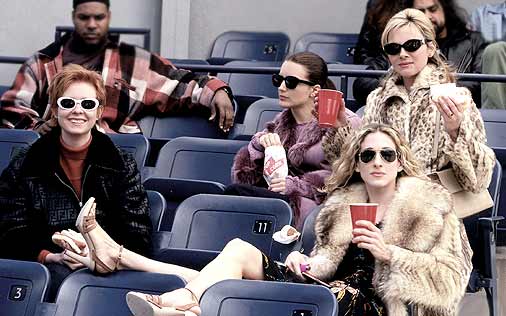
Welcome to the age of un-innocence. In 1998 HBO commissioned a series based on the book 'Sex and the City', by columnist Candace Bushnell. The book was based on a series of columns published by the New York Observer, the book was essentially a novelization of her and her friends lifestyles, and featured many real life new yorkers under pseudonyms, for instance the character of Mr Big was based upon publishing executive Ron Galotti, whom Bushnell dated for several years. The first few series of SATC were based around dating in new york city, characters often broke the third wall, looking into the camera and being frank about relationships. The series followed Carrie Bradshaw as she wrote her column, often using her friends for inspiration.
Subsequently, as the characters of the show became more loved the show became more character driven, and went on to discuss a range of relationship and health issues such as STD's, pregnancy, cancer, anal sex and threesomes. The show was the perfect blend of fashion, gossip and glamor, and became appointment Sunday night viewing. The series featured Sarah Jessica Parker, Kristin Davis, Kim Cattrall and Cynthia Nixon in leading roles. Each character represented an archetype of the New York woman. A feminine fashion loving writer, a Pollyanna gallery owner, a promiscuous PR expert and a tough love lawyer.
The show does for women on their thirties what 'Girls' does for women in their twenties, the characters on the show were perpetually single, and often had frank discussions about the state of their sex lives. The shows protagonist was incredibly realistic about life, and referred to the nineties as 'the age on un-innocence'. New York really was the fifth main character on the show, and the shows entirety was filmed in Manhattan.
Overall SATC was a phenomenon, the series is funny, heartwarming and realistic, and is a great show for single people to binge watch on lonesome tuesday nights in! Welcome to the age of un-innocence!

"Welcome to the age of un-innocence. No one has breakfast at Tiffany's, and no one has affairs to remember. Instead, we have breakfast at 7AM, and affairs we try to forget as quickly as possible" - Carrie Bradshaw


Saturday, 13 July 2013

Top 10 Movie soundtracks

Well, I recently purchased the soundtrack to Baz Luhrmann’s The Great Gatsby from Amazon, and this got be thinking about which movies also had great soundtracks, whether score or song based.

  • The Great Gatsby : Well this one is intriguing. The soundtrack was produced by Jay Z, and thus it is not surprising that Beyoncé appears on the album. The soundtrack is a fun blend of jazz and hip hop, which works surprisingly well, with some ballads thrown in for good measure. The soundtrack matches the high production value of the film, and many of the tracks are highly produced and slick. The soundtrack is epitomized by an Emeli Sandé cover of Beyoncé’s Crazy in Love in typical 1920’s speakeasy fashion. Highlights include ‘Bang Bang’, a rap song which blends sequences elements of ‘Charleston’ and which is devilishly catchy. Young and Beautiful, a beautiful ballad by Lana Del Rey and A Little Party Never Killed Nobody, a song combining elements of techno, EDM and house music, and which it is strangely easy to dance the Charleston to! Unfortunately the album also contains a cover of Back to Black by André 3000 and Beyoncé, which is badly sung and unfortunately completely unnecessary, despite being surprisingly well produced.
   

  • Lord of the Rings/The Hobbit: One of the greatest film scores of all time, composed by Howard Shore, this piece combines orchestral and choral music, creating a musical tapestry. Each place in the film has a different theme, with Concerning Hobbits being The Shires theme, and a particularly celebrated piece of music, featuring a jaunty flute solo. The film also features separate themes for Mordor and Isengard, as well as Rohan and the city of Minas Tirith. The musical score is jaunty and light, and surprisingly catchy during the scenes which take place in the world of the hobbits and the kingdom of men. It is darker, and more folk inspired, and to the layman could be described as ‘rural’ and ‘farmy’, and features more violin solos. The parts of the story that take place in Mordor and Isengard  are very different, featuring thundering chords, and much more chorus than in the other segments. The Hobbit features much music in common with The Lord of the Rings, the score essentially takes the best elements of the trilogy, and adds in some seriously good compositions, which help to show the dwarfs inclusion in the story, with the new music featuring thundering percussion and chorus, which works perfectly with the more rugged aspects of the story, given the increased involvement of the dwarves in this story. Each film uses one original song during the credits, and Into the West, by Annie Lennox, and May It Be by Enya standing out as particular highlights from the third and first movies respectively. Combined these elements help make this one of the greatest scores of all time.

  • Lord of the Rings/The Hobbit: One of the greatest film scores of all time, composed by Howard Shore, this piece combines orchestral and choral music, creating a musical tapestry. Each place in the film has a different theme, with Concerning Hobbits being The Shires theme, and a particularly celebrated piece of music, featuring a jaunty flute solo. The film also features separate themes for Mordor and Isengard, as well as Rohan and the city of Minas Tirith. The musical score is jaunty and light, and surprisingly catchy during the scenes which take place in the world of the hobbits and the kingdom of men. It is darker, and more folk inspired, and to the layman could be described as ‘rural’ and ‘farmy’, and features more violin solos. The parts of the story that take place in Mordor and Isengard  are very different, featuring thundering chords, and much more chorus than in the other segments. The Hobbit features much music in common with The Lord of the Rings, the score essentially takes the best elements of the trilogy, and adds in some seriously good compositions, which help to show the dwarfs inclusion in the story, with the new music featuring thundering percussion and chorus, which works perfectly with the more rugged aspects of the story, given the increased involvement of the dwarves in this story. Each film uses one original song during the credits, and Into the West, by Annie Lennox, and May It Be by Enya standing out as particular highlights from the third and first movies respectively. Combined these elements help make this one of the greatest scores of all time.
 
  • Sex and the City: This might seem like an odd choice, however I think that the use of music in this film was superb, the films soundtrack managed to perfectly blend the light, jazz inspired lounge soundtrack of the original tv series, with a new selection of songs, which were perfectly injected into the film. The use of music in this film is superb, and highlights include a stunning rendition of Auld Lang’s Eyne, used in the film as carrie is running through New York on new year’s eve to Miranda’s apartment in the snow, and a new recording of the original HBO theme, rerecorded by the New York Philharmonic Orchestra, in a typical symphonic fashion.
  • Dreamgirls: Despite being an adaptation of the celebrated Broadway musical, this film features much new material, and received three nominations for best original song at the 2006 Academy Awards. The original material is significantly updated for this film, with the orchestral backing losing the disco inspired, 1970’s feel of the original recordings, and replacing it with a punchier, more big band and jazz inspired sound, focusing more on brass and percussion. Surprisingly as this is often not the case, the films soundtrack is actually better sung that the original soundtrack, and the film’s producers made the smart decision of using performers who were primarily singers in the film, whereas most films do the opposite. Jennifer Hudsons vocal performance in this movie is one of the greatest ever seen on film, with her performance of And I Am Telling You is simply stunning, with the audience being able to feel the pain and desperation in her voice, despite the soundtrack being a prerecord, showing that live singing on film is not always the way to go. (up yours Les Miserables) Other highlights include Listen, featuring a stunning performance by Beyoncé, and Dreamgirls, the film’s title song which shows a smooth, lounge inspired sound, highly appropriate given that The Dreams are very much inspired by The Supremes. 
  • Cloud Atlas: Featuring over two hours of original music, this film contains the most music of any film since Stanley Kubrick’s 2001: A Space Odyssey. Composed by one of the film’s director Tom Twyker, the score manages to be totally timeless. Music is one of the ways this film attempts to link together the various segments of this film is through music, and rather than each segment having its own music, Twyker has composed a timeless classic score. The score works equally well with each segment, and although different motifs are used for each different part, the overall ‘sound’ remains the same. This is a score which transcends time, space and ethnicity, it works equally well on a sailing boat in the pacific in the 19th century as it does in a post-apocalyptic future or in Edinburgh in the 1930’s. The soundtrack is haunting and beautiful, and never stoops to the stereotypical techno music which too often features in modern sci-fi movies. The score is almost entirely orchestral, only occasionally using a chorus, which is often used as an instrument would be, not using words at all. The score features a piece which is described in the film and original novel, called the Cloud Atlas Sextet, the piece is used as a metaphor for the piece as a whole, with the sextet being described as a symphony with six movements, featuring six separate soloists, weaving in between one another, connected but still apart. One wonders if, like 2001: A Space Odyssey, Cloud Atlas will ever feature in live orchestral performances, showings of 2001 with a live orchestra have become quite popular, almost like a highbrow version of midnight showings of The Rocky Horror Picture Show!
  • Moulin Rouge: One of the greatest soundtracks of all time, here the music of the film, essentially shows us the nature of the film itself. Moulin Rouge! Is a jukebox musical, which is set in Paris at the turn of the century, in the famed nightclub and brothel. The movie despite being a period film uses modern camera angles, fast cuts and quick pans, and Luhrmann described how he wanted to recreate the excitement of the Moulin Rouge at the turn of the century for a modern audience, and used many techniques more often seen in music videos. The soundtrack is unique in that it uses modern songs, reproduced and rerecorded in a period style, though not necessarily in a museum way, meaning that the music is evocative of the era whilst perhaps not being entirely true to the music hall style of the period. Music was so important to Baz Luhrmann that he spent a full year simply getting the rights to all the music. The movie features only one original song; Come What May, a song which was in fact written for Romeo + Juliet, and which was thus disqualified from the Best Original Song Category at the Oscars. Highlights of the soundtrack include the Elephant Love Medley, a piece which includes selections from over twenty songs, and which actually manages to combine them into something which resembles a song, and Diamonds are a Girl’s Best Friend, vaguely modernized for the film featuring a new bridge section which uses the chorus of Madonna’s Material Girl. Other highlights include a tango version of Police’s Roxanne, featuring a throbbing, haunting violin solo. Period versions of Grace Jones’ Warm Leatherette and Pull Up to the Bumper, featuring can-can girls in S&M bondage gear, establishing the gothic tower as a brothel was planned but never filmed. Seeing as I am a huge Grace Jones fan I would have loved to see this on film, but it does seem superfluous to the story.  Other than this omission, I really have no other complaints about this soundtrack, and it remains the greatest song driven jukebox soundtrack of all time.
  • Melancholia: Oddly enough this is a jukebox soundtrack featuring classical and baroque music. The film is bookended by the Prelude from Wagner’s Tristan and Isolde, which is deliciously atmospheric. Although the music of this film is perhaps not as memorable and certainly not as catchy as some of the other examples shown here, it is beautifully atmospheric and adds to the already slightly mysterious element of the film. The sheer beauty of the music also mirrors the absolutely beautiful esthetic of the picture, and the beautiful colors used. The music is particularly atmospheric at the very end of the film, as Melancholia is bearing down on earth, and Wagner’s Prelude is roaring over the sound of the planet tearing through earth’s atmosphere.
  • Juno: Light and quirky, this soundtrack matches the tone of the film itself perfectly. The film relies heavily on music by Kimya Dawson, and a cover of Anyone Else But You by Michael Cera and Ellen Page is a highlight. The film is a small, independent movie, and as such the films soundtrack features a lot of small, niche indie music. The films soundtrack is well put together, and successfully matches the tone of the film, while the album actually feels like someone’s music collection, appropriate given that much of the music is diegetic, and the characters are aware if its presence.
 
  • Pirates of the Caribbean: A simply amazing score, the film dispenses with the traditional swashbuckling soundtrack found on most pirate films, and it is instead replaced by a     sumptuous score, which highlights the action adventure elements of the story. The more seafaring elements of the story are highlighted by a more folk sound, featuring violin solos and a jaunty melody. The films theme is simply stunning, and is melodic, symphonic and catchy, making this Hans Zimmer composed score, one of the most fun, and exciting scores, if not as deep or complex as some of the other score based soundtracks featured here.
  • Amadeus: This adaptation of the celebrated jukebox play/musical features much more music than the original, and in excess of five operas are shown in the movie. Whilst none of the main characters of the film actually sing, the use of music in the film is superb, with Mozart’s requiem used for the films epilogue, a cute example perhaps of life imitating art.